KADConsulting Contact usContact

Portfolio

Case studies.

Tap a client to open the full story: what they needed, what we built, what changed, and what we learned along the way.

KADx client · Laundry pickup & delivery · Tucson

LaundryLift

Brand, booking website, Stripe payments, a private driver dashboard, and the security underneath. Live in 9 days
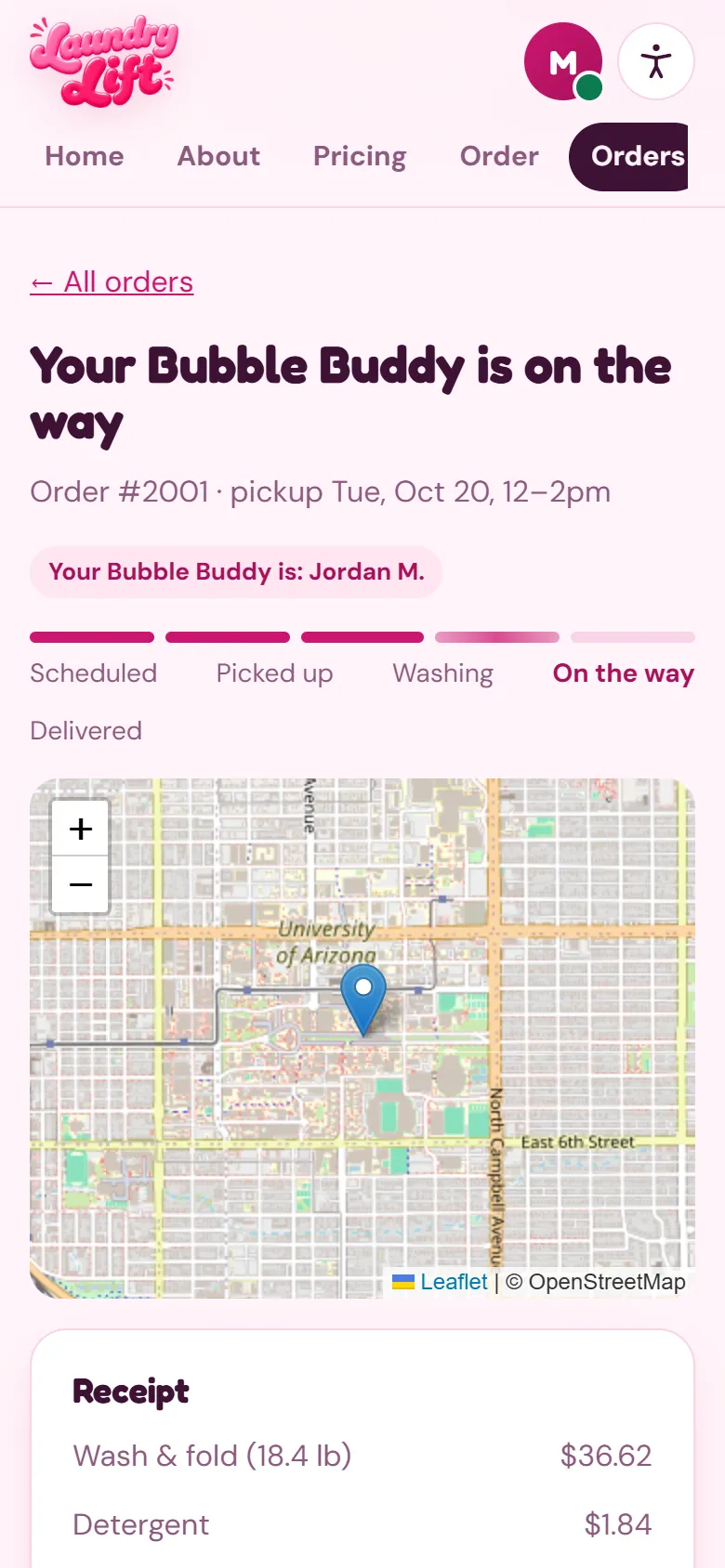
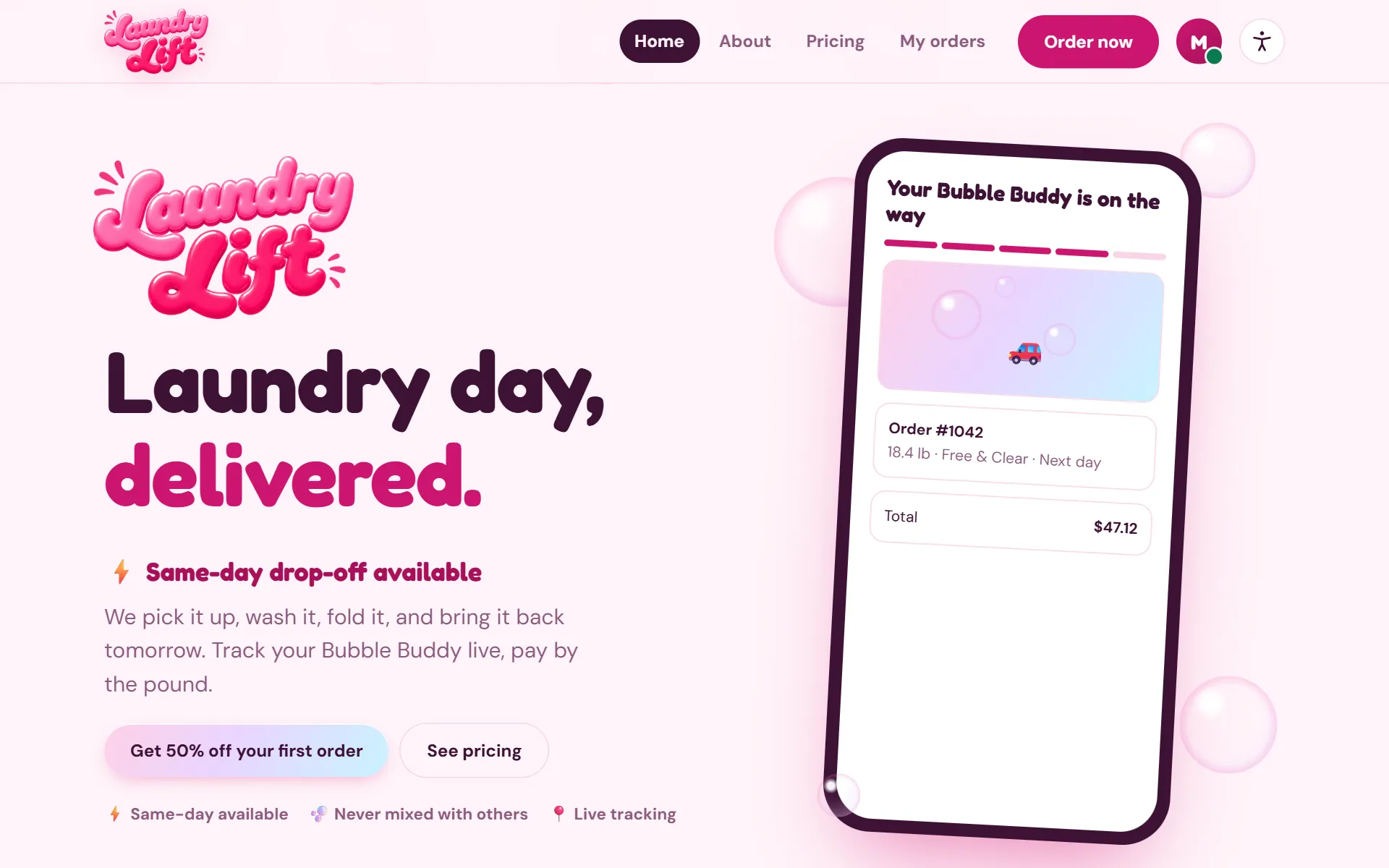
LaundryLift homepage on a laptop: Laundry day, delivered. Order tracking on a phone: Your Bubble Buddy is on the way, with a progress bar and live map
Live at laundryliftaz.com. Signed-in screens in this case study use sample data.

The challenge

A new laundry pickup and delivery business with a brand idea and no technology behind it. Customers needed to book and pay from their phones. Drivers needed to run the day from theirs. And while the business proves itself, it couldn't afford a stack of monthly software subscriptions.

9 days

From kickoff to a live site taking real card payments.

Launch
$0 / month

Fixed software cost. Built on free tiers, so the only costs are card fees on actual sales.

Running cost
3 apps

A customer site, a private driver dashboard, and a mobile app, all on one database.

Scope
121 pages

A plain-English rebuild guide, so the owner never depends on us to keep it running.

Handover

What we built

01

Brand & identity

We turned the founder's logo concept into a finished mark and built a bright soap-bubble look around it. The drivers are "Bubble Buddies." The brand covers the website, business cards, the Lift Pass membership logo, and a full business plan.

LogoBrand systemBusiness cardsBusiness plan
02

Booking website

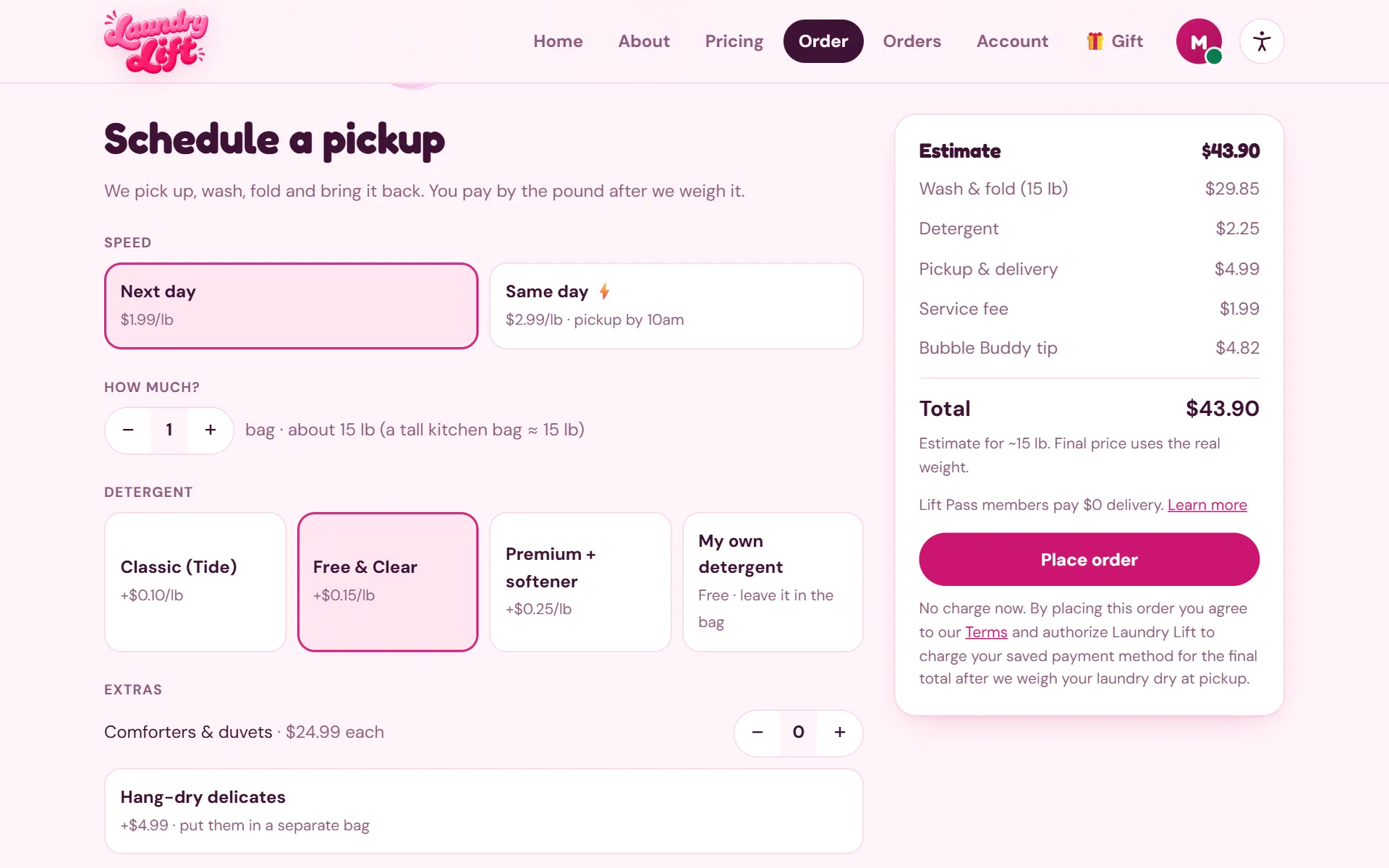
Customers get an instant price quote that updates as they choose, and pick a pickup window from a 15-day calendar that knows about holidays and closed days. They can sign in with Google, track their Bubble Buddy on a live map, buy gift cards, join Lift Pass, and request refunds, all from their phone. The site includes an accessibility menu and the legal pages.

Schedule a pickup page with speed, bag count and detergent choices beside a live price estimate
JavaScriptGoogle sign-inLive mapAccessibility
03

Payments

Built on Stripe. The card is saved at booking and charged only after the laundry is weighed, so customers pay for actual pounds. The system also handles Lift Pass billing, store credit, and refunds, and declined cards are handled automatically. Refunds issued in the Stripe dashboard sync back to the order on their own.

StripeSubscriptionsWebhooksRefunds & credit
04

Split views: a private dashboard for Bubble Buddies

Customers and drivers never share a screen. The Bubble Buddies have their own separate, private site that only staff accounts can open, and it is hidden from search engines. It shows incoming orders as they arrive with no refresh. It also has today's numbers, a "needs attention" queue for refunds and declined cards, and a month calendar of pickups. Each order card has one-tap Navigate, Text, and Call buttons.

Drivers claim orders with a PIN and photograph each pickup and each scale reading as proof. The owner gets an email for every new order.
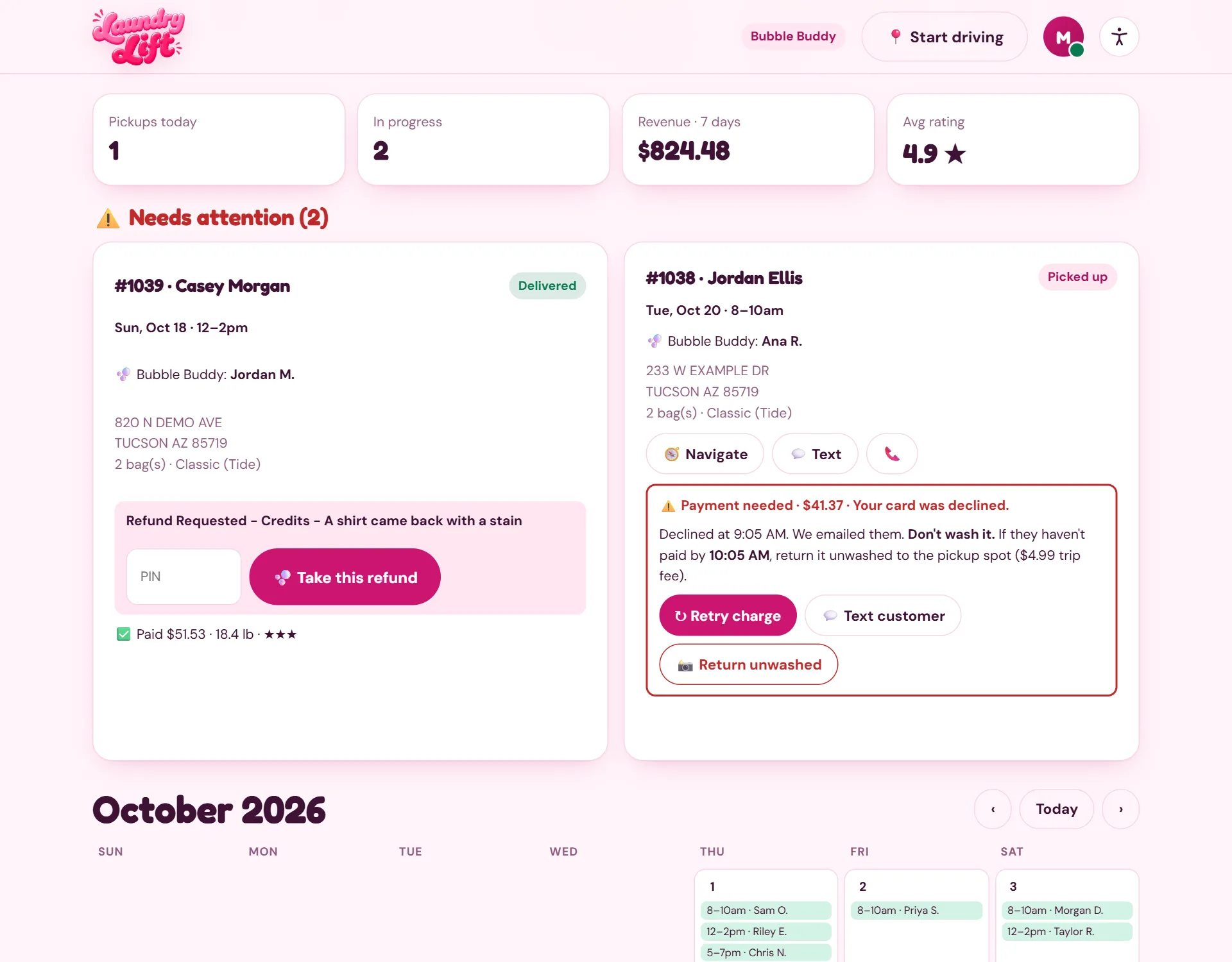
Bubble Buddy dashboard: pickups today, in progress, 7-day revenue and rating, a needs-attention queue, and the month calendar
Role-based accessLive updatesPhoto proofEmail alerts
05

Security

Security was built in from day one rather than added later:

  • Card numbers never touch LaundryLift's servers. Payment details go straight to Stripe, and the server uses a restricted key that can only do what the business needs.
  • The database enforces privacy itself. Row-level security means each customer can only ever see their own orders, whatever the app asks for. Database rules also block customers from changing anything they shouldn't, such as prices.
  • Staff actions are locked down. Only staff accounts can open the driver site. Claiming orders and taking refund requests requires a personal Bubble Buddy PIN, so every action is tied to a person.
  • Every charge is protected against repeats. Charges can't accidentally run twice, and messages from Stripe are checked against a secret signature before they're trusted.
  • Proof photos stay private. They're stored privately and shown only through links that expire.
  • The site is hardened against code injection. A strict security policy means only the site's own code can run, with no outside scripts.
  • Deleting an account actually deletes the data. When a customer closes their account, personal details are scrubbed and only the minimum needed for the books is kept.
Row-level securityContent Security PolicySigned webhooksLeast privilege
06

Data & handover

Everything runs on one Postgres database, and every page and app prices from the same single formula, so the estimate and the final charge can never disagree. Automated tests check the money paths and the permissions. A mobile app is built and ready for the app stores whenever volume justifies it. Everything is documented step by step for the owner.

Supabase / PostgresAutomated testsExpo mobile appDocumentation

What we learned

  • Charge for what you can prove. Laundry is weighed dry before washing and the scale is photographed. Pricing disputes are settled before they start, because the proof is attached to the order.
  • Write the policy into the software. Missed pickups (text, wait five minutes, photo, fee) and declined cards (one hour to pay, then returned unwashed) are enforced by the system. Drivers never have to argue with a customer. The rules do it for them.
  • Refunds aren't free. Stripe keeps its processing fee when a payment is refunded. So refunds to a card come back net of that fee, while store credit is the full amount. That steers customers toward credit and keeps money in the business.
  • Ship the web app first. The owner runs the business from the website saved to a phone's home screen. The app-store versions are built, but they're held back until order volume justifies the fees and review cycles. Every update reaches the phone instantly.
  • The launch checklist is longer than the feature list. Google's sign-in approval, email deliverability, and domain setup each took as much care as a feature did. We now plan for them from day one, so they never hold up a launch.
Before KADx · In-house · Consumer brands

The Wonderful Company FIJI Water · JUSTIN Vineyards

Automation, RPA, AI agents, and a multi-brand data platform. 16 hrs → 15 min

The challenge

A multi-brand portfolio running on legacy SharePoint reporting, manual data entry in logistics scheduling, a month-end audit that ate two working days, and internal knowledge that people had to dig for. Kyle Reep designed and built these systems as an in-house engineer before founding KADx.

16 hrs → 15 min

A month-end document audit and traceability cycle, rebuilt as an automated Python routine.

Automation
50% faster

Refresh latency cut on a 1.6M-row model through query folding and complexity optimization, with sub-second response for global executives.

Performance
+48%

Logistics scheduling efficiency after end-to-end RPA pipelines eliminated manual data entry bottlenecks.

RPA
−65%

Time spent searching for internal information, after custom AI agents were deployed against existing documentation.

Agentic AI
1.6M+ rows

Legacy SharePoint reporting migrated into a centralized Snowflake and Dataverse architecture supporting a multi-brand portfolio.

Data architecture
Plain English

A custom AI assistant inside the JUSTIN Wine executive dashboard lets non-technical leaders ask questions of 1.6M+ rows of sales data, built on LLM integrations and Snowflake Cortex.

AI-powered BI
Dept. first

The sales department's first automated intake and reporting system, replacing manual tracking in Teams.

Systems modernization
SKU-level

Predictive models in Python and SQL surfaced SKU-level sales trends and automated the forecast reports behind JUSTIN Vineyards sales strategy.

Predictive analytics

What we took from it

  • Speed comes from the model, not the hardware. The 50% faster refresh came from restructuring the data model and pushing work back to the source. That's the same approach we use to keep small-business reporting fast on free and low-cost tools.
  • The most-dreaded task is the best first project. A two-day month-end audit turned into a 15-minute routine. Recurring, rules-based, error-prone work is where automation pays back fastest.
  • Search is a hidden payroll cost. A 65% cut in time spent hunting for information shows how much a business spends just finding what it already knows.
PythonUiPath RPASnowflakeDataversePower BICopilot Studio
Before KADx · In-house · Government programs

Maximus Texas Medicare & Arizona DES contracts

Reporting automation, root-cause analysis, IT workflow automation, and systems monitoring. −32% review time

The challenge

Large government contracts, a Texas Medicare program and Arizona's Department of Economic Security, where executive status reports were assembled by hand, IT support ran on manual tracking, and system anomalies and data silos were slowing program-wide throughput. Kyle Reep did this work in-house before founding KADx.

−32%

Executive reporting review time, after manual aggregation was replaced with automated status generation.

Reporting automation
+16.8%

Program-wide data throughput following SQL-based root cause analysis on system anomalies and data silos.

Root cause analysis
1-hour SLA

A manual IT support desk rebuilt as an automated ticketing system in Smartsheet and Power Automate, with a one-hour resolution target.

Workflow automation
99.9% uptime

Health monitoring on high-security government systems, in line with federal data and cybersecurity standards.

Infrastructure monitoring

What we took from it

  • Find the bottleneck before buying software. The throughput gain came from tracing where the data was getting stuck, not from adding a new tool. Our free assessment starts the same way.
  • Automate the report and the double-checking goes too. Status generated straight from the source data doesn't need someone to re-add the numbers before it reaches an executive.
SQLPythonPower BIPower AutomateSmartsheetRoot cause analysis

What this means for you

Big-company systems, sized for a small business.

The same person who built data systems for FIJI Water and government programs like Texas Medicare builds yours. Here's what that looks like when you're the client.

Live in weeks, not quarters.

LaundryLift went from kickoff to taking real payments in nine days. You see working software early, not a slide deck.

No monthly software rent.

We build on tools that cost little or nothing to run. Websites start at $400 with no Squarespace or Wix subscription. Most clients pay for little more than the domain name.

You own all of it.

The code, the accounts, the data, and the documentation are in your name. If you never call us again, everything keeps running.

Built for how you actually work.

Customers book and pay from their phones. Your team runs the day from theirs, on their own private view. You get an alert the moment a new order comes in.

Security built in from day one.

Card data never touches your server. Each customer sees only their own records, and staff actions are tied to a person. It's built in, not bolted on.

A manual, not a mystery.

Every build ships with a plain-English runbook and training for your own people, so you're never stuck waiting on a developer.

Have something like this in mind?

Start with a free assessment. Sixty minutes, no charge, no obligation. You'll leave with a fixed price before anything is built.

Contact us